
Portable Wired Fish Finder
4.3Editor score
45-degree sonar beam
328-foot depth range
Five sensitivity levels
Neck strap included
A portable depth and fish finder for kayak can reveal water depth, temperature, submerged structure, and nearby fish without requiring a permanent hull installation. The most useful models suit small cockpits, remain readable in changing light, and provide dependable sonar information without cables restricting paddle movement.
This guide compares ten portable fish finders using the specifications and features supplied for each product, including sonar type, wireless range, depth capability, display size, power method, navigation functions, and kayak-friendly mounting options. It covers castable wireless units, wired handheld sonar, compact fixed displays, and broader portable kits.
Each review identifies the product's most useful characteristics, practical trade-offs, and ideal angling situation. Ratings and specifications reflect the supplied listing information, while feature emphasis comes from the published product details. Availability, configurations, and prices can change, so confirm the current listing before buying.
4.3Editor score
4.6Editor score
4.2Editor score
As an Amazon Associate we earn from qualifying purchases.
The comparison below highlights the differences in sonar configuration, reach, display, power, and portability. These specifications help separate lightweight castable systems from wired handhelds, permanently mounted displays, and navigation-oriented portable kits.


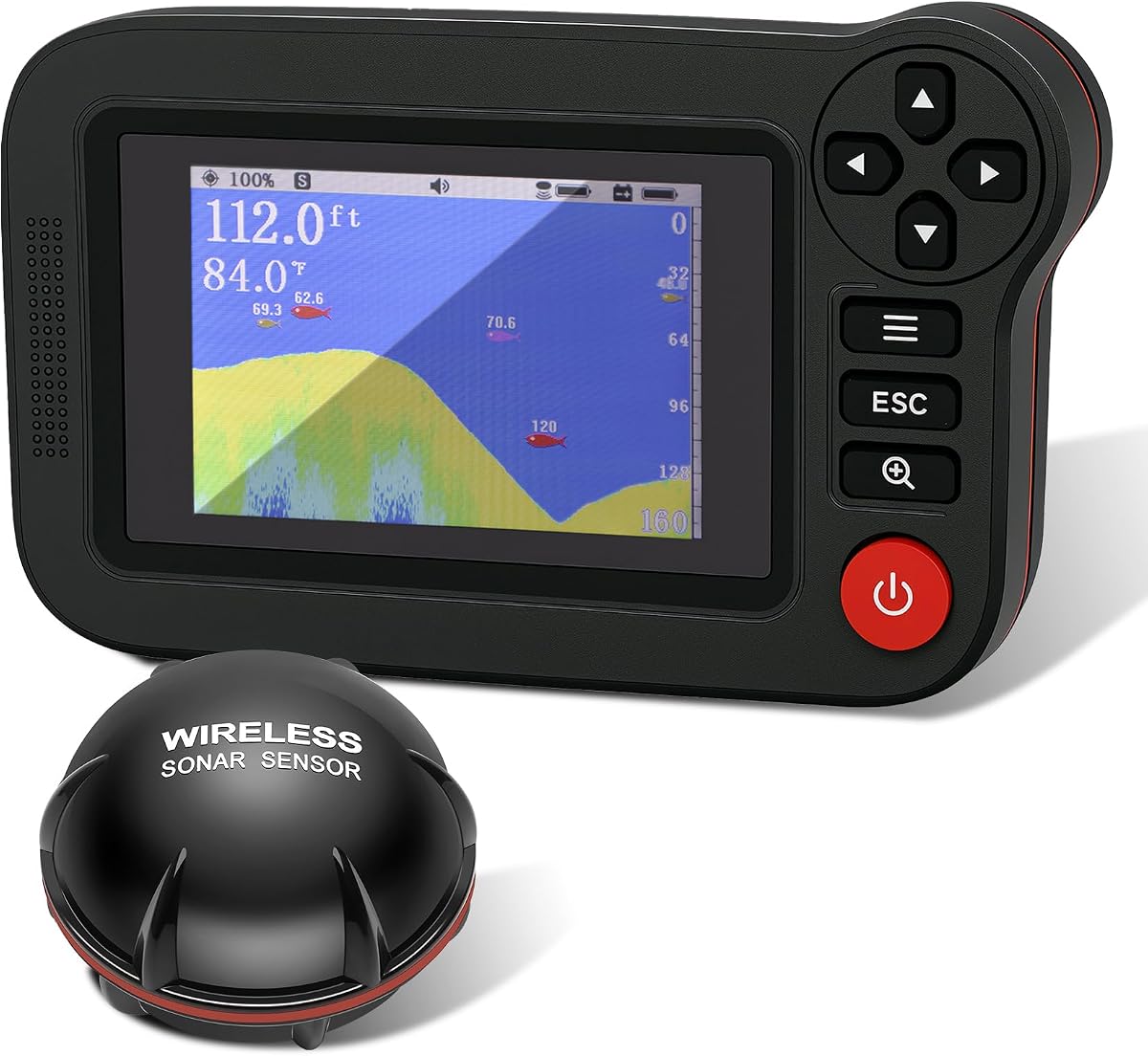
The Portable Rechargeable Fish Finder is a compact wireless system with a 4.3 rating and a feature set aimed at anglers who want sonar information without installing a transducer permanently in a kayak. It pairs a handheld color LCD with a castable probe that can be tethered to fishing line, making it well suited to shallow lakes, rivers, shorelines, and other variable water.
We may earn a commission when you buy through this link, at no additional cost to you.
The probe communicates with the display across a maximum distance of 262 feet, while its sonar beam covers 105 degrees and its depth range extends from 2.6 to 164 feet. The display presents depth, temperature, approximate fish size, fish depth, and bottom contour. Selectable black and white screen backgrounds help anglers switch between bright daylight and darker conditions.
Its main trade-offs are the relatively short wireless range and the absence of the GPS waypoint features found in more advanced fixed-display systems. The product also requires care when interpreting the probe's battery indicator while the sensor is out of the water, as the supplied instructions explain that the accurate status appears after the probe is placed in water.
This is a compelling choice for paddlers who value cable-free deployment, a broad depth range, and immediate information about fish and bottom structure. It is less suitable for anglers who need to mark routes or search a large area remotely, but for direct structure finding it offers a practical balance of portability, readability, and useful sonar data.
The wireless probe can be cast ahead of the kayak and retrieved by its tether, eliminating a permanently routed cable. That freedom is valuable in narrow waterways where loose lines and hull-mounted hardware can interfere with paddling.
Showing water depth, temperature, fish depth, fish-size categories, and bottom contour gives a more complete picture than a basic depth-only readout. The wide sonar beam also helps cover more water around the deployed sensor.
We may earn a commission when you buy through this link, at no additional cost to you.
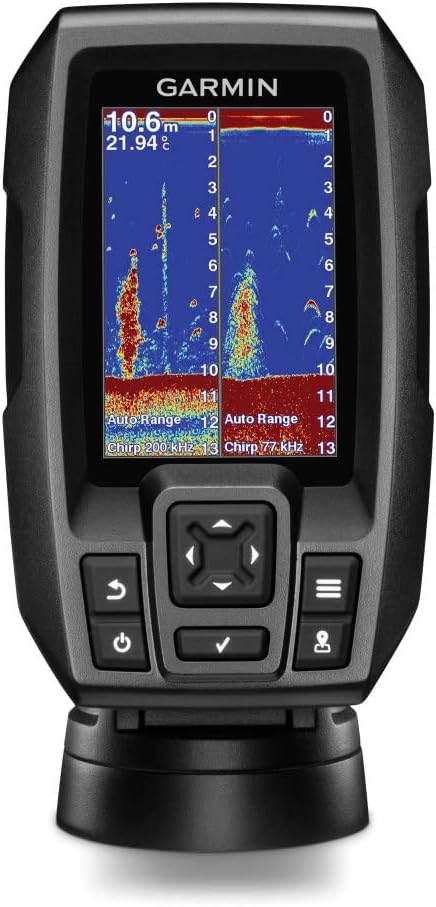
The Garmin Striker 4 combines a compact 3.5-inch display with ClearVu scanning sonar, CHIRP technology, and GPS waypoint navigation. Its 4.6 rating reflects a capable, established feature set for anglers who want detailed structure information and the ability to mark productive fishing locations.
We may earn a commission when you buy through this link, at no additional cost to you.
ClearVu is designed to produce detailed representations of fish, objects, and structure, while CHIRP sends a continuous sweep of frequencies to create crisper fish arches and better target separation. Maximum depth reaches 1,600 feet in freshwater and 750 feet in saltwater, and the waypoint map supports marking locations such as brush piles, stumps, and docks.
The primary limitation is installation. Unlike a castable wireless unit, this package requires a transducer mounted to the boat or kayak hull, and the relevant kayak-specific mount is associated with the separate portable-kit listing reviewed later. It also lacks the larger color screen, route creation, speed display, and automatic contour mapping found in the STRIKER Vivid 4cv.
The Striker 4 is an excellent match for an angler willing to install a compact fixed system. It offers a rare combination of detailed sonar, strong depth capability, easy controls, and GPS waypoint tools in a small display, making it a more complete long-term kayak setup than a basic wired handheld.
ClearVu scanning sonar and CHIRP are the centerpiece advantages. They help distinguish individual fish arches and submerged structure, which is valuable when searching drop-offs, weed edges, submerged timber, and similar features.
GPS waypoint mapping turns the unit into more than a depth display. Anglers can mark a productive area and return to it later, especially helpful on lakes with extensive structure or a network of coves.
We may earn a commission when you buy through this link, at no additional cost to you.
The Portable Wired Fish Finder is a straightforward handheld system for kayakers who want depth, approximate fish location, size categories, and bottom composition information. Its 4.3 rating and easy-to-use design make it a practical entry point, particularly for anglers fishing from a kayak, dock, shore, or ice.
We may earn a commission when you buy through this link, at no additional cost to you.
The transducer uses a 45-degree beam and detects depths from 3 to 328 feet. Five selectable sensitivity levels, a battery-saver mode, backlight, fish alarm, and unit selection help adapt the display to different conditions. It runs on four AAA batteries, with the supplied information indicating approximately four to five hours of continuous use.
The wired design creates the clearest compromise in this list. A connected cable must run from the handheld unit to the sensor, which can require more attention in a kayak than a wireless probe. The 45-degree beam also covers less water than several 90- and 105-degree alternatives, and the display offers no stated GPS or mapping functions.
Despite those limits, this model covers the essential needs of a portable kayak setup with a strong stated depth range and useful fish-size estimates. It is best for beginners, casual anglers, and anyone who prefers a simple sensor that can be tossed beside the kayak rather than a complex permanent installation.
Tossing the sensor into the water and switching on the display is straightforward. A neck strap allows the user to wear the unit while paddling or fishing, and its compact size makes storage in a tackle box straightforward.
Beyond depth, the display identifies short and tall weeds along with sand and rocks. This helps anglers interpret the immediate bottom and choose a presentation suited to the type of cover they find.
We may earn a commission when you buy through this link, at no additional cost to you.
The Portable Castable Fish Finder stands out for a maximum transducer-to-screen distance of 656 feet, the longest wireless reach among the castable systems in this comparison. Its 4.2 rating reflects a feature-rich package for anglers who want to cast a sonar probe ahead and retrieve information from a distance.
We may earn a commission when you buy through this link, at no additional cost to you.
It detects depth, temperature, fish size, fish depth, and bottom contour through a 105-degree beam with a depth range of 2.6 to 164 feet. The 3.5-inch TFT display offers black, blue, and white background options for changing ambient light, while fish, depth, and background-switching functions add useful control.
Its rechargeable wireless probe charges in about two hours and provides approximately eight hours of working time. The main unit accepts 5V or 12V power, and the supplied information notes low-battery monitoring. Compared with simpler wired handhelds, it requires more charging discipline, but it eliminates a long cable across the kayak.
This model is a strong choice for mobile anglers searching drop-offs, channels, weed edges, or fish-holding structure from a distance. It is not as navigation-focused as the Garmin units, and the sensor must remain in suitable wireless range, but its range, screen customization, and alarm suite make it a capable premium portable setup.
A 656-foot maximum wireless distance allows the sensor to be placed farther from the kayak than most compact castable competitors. This expands the area that can be searched without a long cable crossing the angler's workspace.
Three background choices make it easier to read the screen under bright sun, overcast conditions, or low light. The larger TFT format also presents more information than the smallest handheld color screens in the comparison.
We may earn a commission when you buy through this link, at no additional cost to you.
The DANOPLUS Portable Fish Finder is a compact wireless option centered on a 2.4-inch color LCD, a rechargeable castable sensor, and a 147-foot depth capability. Its 4.3 rating makes it an appealing option for anglers seeking a simple way to add depth, temperature, and fish information to a kayak.
We may earn a commission when you buy through this link, at no additional cost to you.
Its sonar covers a 90-degree area and reports water depth, temperature, bottom contour, water surface, and fish icons with size and depth. The unit supports 21 operating languages, broadens its appeal for different users, and includes a fish alarm that displays and sounds when fish enter the sensor's coverage.
A distinctive attraction lamp automatically activates when the wireless sensor touches water. That feature may help draw attention near the probe, though the unit's effectiveness still depends on sonar interpretation, local conditions, and angling technique. The 2.4-inch screen and 147-foot range are more modest than those of the larger castable Garmin alternatives.
This fish finder works best for anglers who want a lightweight wireless package with a simple display and fish alarm. It is less suitable for deep reservoirs or anglers who need broad navigation functions, but its rechargeable probe and compact format fit comfortably into a portable kayak fishing kit.
The illuminated sensor is designed to activate automatically when placed in the water. Its visible tip can help identify the probe's position in dim conditions or add a visual point of interest around the sonar coverage.
The built-in fish alarm provides both an on-screen indication and an audible signal when fish pass through the covered area. Fish size and depth are shown to add context to each alert.
We may earn a commission when you buy through this link, at no additional cost to you.
The Garmin Striker 4 with Portable Kit is the highest-rated product in the group, with a 4.7 rating. Its defining advantage is the included kayak in-hull transducer mount, which makes it a purpose-built choice for paddlers who prefer a fixed sonar installation over a castable sensor.
We may earn a commission when you buy through this link, at no additional cost to you.
The kit retains the straightforward keyed interface, CHIRP sonar, waypoint map, and built-in flasher of the Striker platform. CHIRP provides a continuous frequency sweep for crisper fish arches and better target separation, while maximum depth reaches 1,600 feet in freshwater and 750 feet in saltwater. The flasher display supports vertical jigging and ice-fishing techniques.
A fixed in-hull setup offers a consistent sensor angle and avoids managing a long sensor cable, but it requires drilling or otherwise preparing the kayak hull. That permanent modification can be a decisive drawback for owners of rental boats, inflatable craft, or kayaks they may sell later.
The kit is best for a committed kayak angler who values proven sonar detail, navigation, and a dedicated mounting solution. Its high rating and kayak-specific hardware justify a more permanent setup, while anglers seeking minimal installation should look toward the wireless castable models in this guide.
The included in-hull transducer mount is the key distinction from the standard Striker 4 package. It helps an angler establish a repeatable installation and keep the transducer in a consistent position beneath the kayak.
Dedicated buttons and the flasher-style view keep operation straightforward. Anglers can use the display for continuous sonar information or switch formats when vertical jigging conditions make a compact target view more useful.
We may earn a commission when you buy through this link, at no additional cost to you.
The Garmin STRIKER Vivid 4cv is the most visually capable unit in the comparison, with a 4-inch color screen, vivid scanning-sonar palettes, high-sensitivity GPS, and Quickdraw Contours. Its 4.6 rating reflects a strong balance of sonar detail, navigation, and user-friendly controls.
We may earn a commission when you buy through this link, at no additional cost to you.
The included GT20 transducer supports Garmin CHIRP traditional sonar and CHIRP ClearVu scanning sonar. Color palettes help distinguish fish from structure, while the GPS can mark waypoints, create routes, and display boat speed. Quickdraw Contours mapping adds a deeper look at surrounding depth changes, useful for understanding drop-offs and irregular bottom contours.
Compared with a castable wireless unit, the Vivid 4cv occupies more cockpit space and depends on a fixed transducer and power connection. It also offers far more mapping and navigation capability, making it better suited to anglers who use sonar to chart areas rather than merely check depth beside the kayak.
This is the premier full-featured choice for a permanently equipped kayak. It rewards anglers with a large, colorful display and strong navigational tools, while its added complexity may not be necessary for someone who only needs a portable depth reading and basic fish-location data.
Vivid scanning-sonar color palettes make it easier to distinguish fish returns from bottom structure, submerged vegetation, and drop-offs. The larger four-inch screen gives those visual distinctions more room to develop.
Waypoint marking, route creation, speed display, and Quickdraw Contours extend the unit beyond sonar. Together, they help an angler navigate between areas and understand how the bottom changes around a productive location.
We may earn a commission when you buy through this link, at no additional cost to you.
The Portable Wired Fish Finder is a protected handheld alternative to the other wired model in this guide. It has a 4.2 rating and focuses on portable sonar, bottom identification, adjustable sensitivity, and a storage setup intended to protect the display from splashes, bumps, and scratches.
We may earn a commission when you buy through this link, at no additional cost to you.
The unit reports depth, approximate fish location, fish-size categories, short and tall weeds, sand, and rocks. Its 45-degree beam reaches 3 to 328 feet, and five sensitivity levels allow the user to adjust the response. Backlight, battery-saver mode, fish alarm, unit selection, and retained settings round out the feature set.
The included water-resistant bag and protective storage case are useful for wet environments, but they do not eliminate the need to route a cable between the sensor and display. Its approximate fish categories and bottom readouts are less detailed than the contour, navigation, and mapping tools available in the Garmin models.
The product is a sensible option for anglers who favor an inexpensive, straightforward handheld and want better physical protection than a bare display. It suits kayak, dock, shoreline, and ice fishing, while the long range makes it useful across a variety of water depths.
A water-resistant bag and hard storage case help protect the display from splashes and accidental impacts. These accessories are particularly useful when the unit lives in a wet tackle locker or remains aboard a kayak.
Five selectable sensitivity levels give the user some control over how the unit responds to returning signals. The setting can be retained when the display is switched off, reducing repeated configuration.
We may earn a commission when you buy through this link, at no additional cost to you.
The Portable Castable Fish Finder is a wireless 3.5-inch TFT system with a 500-foot maximum transducer-to-screen distance. Its 4.2 rating reflects a balanced design that provides broad fish and structure data while avoiding a permanent hull installation.
We may earn a commission when you buy through this link, at no additional cost to you.
The wireless probe detects depth, temperature, fish size, fish depth, and bottom contour through a 105-degree beam. Its 2.6-to-164-foot depth range is substantial, and adjustable sensitivity, depth range, background switching, fish alarms, and depth alarms provide useful control from the main display.
The main unit supports 5V or 12V power, while the probe uses 5V and needs about two hours to charge. It offers approximately eight hours of continuous operation, and both the unit and probe include low-battery alerts. The absence of stated GPS and route functions keeps it focused on sonar rather than navigation.
This is a well-rounded option for an angler who wants a castable probe, a sizable sunlight-readable screen, and solid wireless range without moving into a permanent installation. It is particularly suitable for exploring structure ahead of the kayak, marking productive areas mentally, and changing locations quickly.
A 500-foot maximum range gives the probe enough separation to survey areas ahead while remaining below the reach of the 262-foot model in the comparison. The 105-degree beam provides a broad view around the deployed sensor.
Low-battery alerts on both the display unit and wireless probe help prevent an unexpected loss of sonar coverage. The stated eight-hour working period offers enough capacity for a full day when the probe is charged before departure.
We may earn a commission when you buy through this link, at no additional cost to you.
The Humminbird PiranhaMAX 4 is a fixed-display sonar with a 4.6 rating and a traditional dual-beam design. It includes a tilt-and-swivel mount and an XNT 9 28 T transom-mount transducer, making it an established option for anglers who want to choose between detail and coverage.
We may earn a commission when you buy through this link, at no additional cost to you.
Its narrow beam provides more precise fish, structure, and contour information, while the wide beam covers a broader area. The ability to choose between them is useful when scanning general terrain or focusing on a specific target. The adjustable mount allows the display angle to be changed to suit the cockpit and viewing position.
The supplied listing does not emphasize GPS waypoint mapping, contour mapping, wireless casting, or a large color display, so its appeal rests on sonar selection and familiar physical controls. The included transom-mount transducer may also require adaptation or a different mounting approach for many kayaks.
The PiranhaMAX 4 is most appropriate for a permanently rigged small boat or a kayak setup that can accommodate a suitable transducer mount. It offers a balanced choice of precise and broad sonar views, making it a practical alternative for anglers who want more coverage control than a basic handheld provides.
The narrow beam concentrates on detail, while the wide beam covers a more generous area. Choosing between them allows the display to suit broad reconnaissance or a closer look at a particular target.
The tilt-and-swivel mount makes it easier to align the display with the angler's preferred viewing angle. This is especially useful in small boats and kayaks where visible space and mounting positions are limited.
We may earn a commission when you buy through this link, at no additional cost to you.
The right kayak fish finder depends on installation tolerance, navigation goals, fishing depth, display visibility, and power requirements. Comparing those factors before purchasing helps prevent an unsuitable system from being chosen solely on the broadest specification.
Wireless sonar removes the sensor cable from the kayak, giving paddlers more freedom and reducing the need to route wiring around a compact cockpit. Castable wireless systems are particularly useful when an angler wants to place the probe ahead of the kayak, check a drop-off, or move quickly between locations without managing a long lead.
A wired system can be simpler in one respect because its sensor is already connected to the display, although the cable still must be handled safely. Fixed-transducer systems are different again because the sensor is permanently mounted beneath the hull. Decide first whether minimal installation matters more than the stability and consistency of a fixed sensor.
Maximum depth matters most when fishing reservoirs, deep lakes, drop-offs, or channels, but it should be considered alongside realistic local conditions. The castable products in this guide reach as deep as 164 feet, while the Garmin Striker models extend to 1,600 feet in freshwater. Beam angle also shapes the covered area, with 90- and 105-degree options covering more than the 45-degree wired units.
A broad beam is useful while moving slowly or searching unfamiliar water, while a narrower beam can concentrate detail around a smaller area. Rather than selecting solely by the largest stated number, match the sensor's coverage to the kind of structure and depth you expect to fish.
A kayak display must be readable without taking up too much cockpit space. The 2.4-inch DANOPLUS screen favors portability, the 3.5-inch units balance information density and size, and the four-inch Garmin STRIKER Vivid 4cv offers the most visual detail. Color can make fish arches and bottom structure easier to distinguish, particularly with vivid sonar palettes.
Outdoor conditions also matter. Selectable black, blue, and white backgrounds on the larger wireless models are designed to accommodate bright sun and lower light. A larger screen is advantageous for interpreting contours and fish arches, but a compact display may be more practical when gear storage and paddle clearance are priorities.
GPS waypoints are valuable when an angler finds productive structure that cannot be described easily by landmarks. The Garmin Striker 4 can mark and navigate to brush piles, stumps, docks, and other saved locations. The STRIKER Vivid 4cv goes further with routes, speed information, and Quickdraw Contours.
These features suit anglers who repeatedly work the same lake or need to move between distant fishing areas. A handheld depth finder without GPS is lighter and more focused, but it relies on visual memory or written notes. Choose navigation when repeatable location management is important; choose simplicity when the primary task is checking depth and nearby fish.
A useful fish finder should provide more than a single depth number. Several products display approximate fish depth and size categories, while others add bottom contour, weed, sand, and rock indications. These readings help an angler decide where to position, which lure or bait may suit the cover, and whether a drop-off is approaching.
Fish-size readings remain estimates rather than measurements of individual species, so they should be treated as guidance. A broader sonar beam and higher-resolution display can make the information more useful, but interpreting the signal still depends on water conditions and the angler's experience.
Power requirements vary substantially across the guide. The portable wired models use four AAA batteries, with the supplied information indicating roughly four to five hours of continuous operation. Castable systems use rechargeable probes that provide around eight hours of working time after a two-hour charge, while their main displays accept 5V or 12V power.
For a full day of fishing, spare batteries or a dependable charging plan is important. Rechargeable sensors reduce battery waste but need to be charged before the trip, while AAA-powered displays are convenient to top up in the field. Check the intended charging source and confirm how the product's battery indicators behave before relying on them.
Fixed sonar provides a consistent transducer position but may require drilling into the hull, altering the kayak permanently. The Garmin Striker 4 Portable Kit includes an in-hull transducer mount for that purpose. The Humminbird PiranhaMAX 4 includes a transom-mount transducer, which may need adaptation for a kayak.
Portable handhelds and castable systems avoid permanent structural changes and are easier to transfer between craft. The best portable solution should fit in a tackle box, allow use of a neck strap, and leave enough room for paddles, lines, and landing fish. Consider both the display's footprint and the space needed to manage its cable or probe.
Wireless range determines how far the probe can be cast or positioned away from the display. The listed maximum distances range from 262 feet to 656 feet among the wireless models. Greater reach is useful for searching ahead, but it does not increase the stated depth capability and may not be necessary on narrow rivers or small lakes.
A tether through the sensor's small hole allows recovery by the fishing line. Check that the line and sensor are deployed in a way that will not snag the kayak or allow the probe to be lost. For wired systems, plan how the cable will remain clear of the paddle, line, and landing area.
Before the first outing, read the included instructions, identify the transducer or probe, and verify every connector. For a wired model, route the cable where it will not interfere with paddles, fishing line, or a landing net. For a wireless model, charge the probe fully, pair it with the display, and learn how the battery indicator behaves when the sensor is dry or floating.
Deploy the sensor from a stationary position whenever possible. Cast the tethered probe ahead, allow it to settle, and begin reading depth and bottom information before moving the kayak. If the display provides sensitivity, depth-range, noise-filter, or background controls, change them gradually and observe how the readings respond. Mark or note productive locations when the unit supports waypoints.
After fishing, switch off the display, retrieve the sensor, and disconnect wired components by their intended connection method. Rinse exposed parts with fresh water when permitted, allow them to dry, and keep the transducer away from freezing conditions. Store the unit in its case or a dry compartment, recharge it according to the instructions, and inspect the cable, connector, lanyard, and mounting hardware before the next trip.
No, not if you select a portable handheld or castable wireless model. These systems use a tethered sensor or probe and do not require a permanent hull opening. A permanently installed unit, such as one using an in-hull transducer, may require drilling or another hull-preparation method, so check the mounting requirements before purchase.
The simplest approach is a portable unit with a neck strap, a sensor that can be deployed without complicated controls, and an automatic power-on process. Wireless castable models reduce cable management, while basic wired handhelds keep the sensor connected. The best choice depends on whether you prioritize mobility, simple handling, or a fixed installation.
No. A deeper range is useful only if the target water contains structures at those depths. For shallow rivers, marshes, and lakes, a moderate range is sufficient. Beam angle, screen clarity, fish data, and deployment convenience may matter more than the largest possible depth number.
Several products in this guide are described for both freshwater and salt or sea water, while the Garmin Striker models specify separate maximum depths for freshwater and saltwater. Always check the current manufacturer instructions and product listing for environmental and operating limits before taking any unit into the water.
A castable fish finder sends a tethered wireless probe ahead of the kayak and retrieves it afterward. It is cable-free and highly portable. A fixed fish finder mounts the transducer beneath the hull for a consistent sensor position. Fixed systems often include stronger navigation features but require more installation and cockpit planning.
Only models with GPS waypoint or mapping functions can store locations electronically. The Garmin Striker 4 supports waypoint marking, while the STRIKER Vivid 4cv adds routes, speed information, and Quickdraw Contours. Basic handheld and castable units generally require the angler to remember or manually record a successful location.
Keep the display in a protected compartment when it is not in use, and use a neck strap or secure mount so it cannot move around the cockpit. A water-resistant case adds protection from splashes, impacts, and scratches. Retrieve sensors carefully, rinse them as directed, and keep connectors dry during storage.
A wireless probe offers more freedom because no long cable crosses the kayak, and it can be cast ahead to search separate areas. A wired sensor may be easier to keep in a consistent position and avoids probe-battery management. The best choice depends on installation preference, fishing style, and how often the kayak changes location.
The Garmin Striker 4 stands out as the most complete balance of detailed sonar, CHIRP technology, and GPS waypoint navigation. The Portable Wired Fish Finder offers the most straightforward entry into portable fish finding, while the Portable Castable Fish Finder provides the longest stated wireless reach among the castable systems reviewed.
Prioritize the features that match your actual fishing method. Choose wireless deployment for mobility, a fixed installation for consistent sensor placement, detailed color sonar for interpreting structure, and GPS tools for returning to marked areas. Battery life, screen visibility, mounting space, and depth requirements are equally important once the core sonar format is selected.
Before purchasing, verify the current configuration, included transducer or probe, mounting hardware, power method, and warranty details on the seller's listing. Prices, availability, and product bundles can change, so the current listing should be treated as the final source for purchase information.