
ROVE R2-4K Dual
4.4Editor score
Front and rear recording
Sony STARVIS 2 sensor
Included 128GB memory card
Our Rove Dash CAM guide compares ten leading dash cams and accessories across video quality, night visibility, parking mode, GPS, storage, and ease of use
A useful dash cam should capture useful evidence without making daily driving more complicated. Rove models range from straightforward front-facing recorders to dual-camera, three-channel systems with night sensors, GPS, touchscreens, and parking surveillance. The right choice depends on how many viewpoints you need and how quickly you want to transfer footage.
We compared the ten featured products using resolution, low-light performance, viewing angle, storage support, parking features, wireless connectivity, navigation data, installation requirements, and included accessories. The list covers ROVE dash cams, compatible ROVE equipment, and several closely related alternatives that help explain the available feature sets.
Each review identifies the product that best serves a particular need, from front-and-rear coverage to compact installation and three-channel monitoring. Ratings and technical details reflect the supplied product information, while package contents and compatibility can change. Always check the current listing, warranty, and included accessories before ordering.
4.4Editor score
4.4Editor score

4.3Editor score
This side-by-side overview compares each camera's recording channels, image sensors, connectivity, navigation features, parking support, storage, and package contents. It makes it easier to distinguish a front-and-rear ROVE system from a three-channel model, a compact alternative, or the hardwire kit needed for parking surveillance.


The ROVE R2-4K Dual is a two-camera dash cam that records the road ahead and behind at the same time. It carries a 4.4 rating and stands out for offering an upscaled 4K front image, Full HD rear coverage, a Sony STARVIS 2 front sensor, dual-band WiFi, and an included 128GB microSD card. The complete package makes it especially approachable for first-time dash cam owners.
We may earn a commission when you buy through this link, at no additional cost to you.
Its front camera captures at 2.5K and upscales that image to 2160p for playback, while the rear camera records at 1080p. Because the 4K output is upscaled rather than native, it should not be confused with the R2-4K Dual PRO. Even so, the stated goal is sharper everyday detail than a standard 1080p dash cam, with an F1.5 front aperture, HDR, and the STARVIS 2 IMX675 sensor supporting difficult lighting conditions.
Connectivity and parking functions add practical value. Dual-band WiFi can move video to a phone at up to 20 MB/s, while built-in GPS records routes, locations, and speed. Parking mode offers time-lapse, motion detection, and collision detection, with triggered events locked into a separate folder. The main compromises are the upscaled front resolution and the need to purchase a compatible hardwire kit for continuous parking power.
Choose the R2-4K Dual if you want meaningful front-and-rear coverage, strong night performance, an included memory card, and smartphone access without moving into a premium tier. It is a particularly sensible recommendation for commuters, rideshare drivers, and families who want a complete two-camera system that is easier to install and manage.
The Sony STARVIS 2 IMX675 sensor and wide F1.5 aperture are the main strengths for low-light journeys. HDR also helps balance bright headlights against darker surroundings, while the rear camera uses an F1.8 aperture for less demanding scenes. Together, these features make the dual system more useful for evening commutes than a basic 1080p recorder.
The included ROVE PRO 128GB card removes the need to select storage separately, and the camera supports larger cards when more capacity is needed. The ROVE app provides live viewing, recording management, and downloads at up to 20 MB/s. Built-in GPS also adds route, compass, and speed information to stored videos.
We may earn a commission when you buy through this link, at no additional cost to you.
The ROVE R2-4K Dual PRO is the premium two-camera option in this guide. It has a 4.3 rating and moves beyond the standard R2-4K Dual with native 4K front recording at 3840 by 2160 pixels and 2K rear footage at 2560 by 1440 pixels. That distinction makes it appealing to drivers who want maximum detail from both the road-facing and rear-facing cameras.
We may earn a commission when you buy through this link, at no additional cost to you.
Both cameras use Sony STARVIS 2 sensors, with the IMX678 serving the front and the IMX675 handling the rear. Their F1.7 and F1.55 apertures, HDR, and wide 150-degree front and 140-degree rear lenses are designed to improve low-light visibility and cover substantial areas around the vehicle. The system also supports dual-band WiFi 6 transfers at up to 30 MB/s, reducing the delay when moving 4K clips to a phone.
Quad-mode GPS supports GPS, BeiDou, Galileo, and GLONASS, while the on-screen display shows speed, compass direction, and timestamp. A 128GB ROVE PRO card and a ROVE Ultimate circular polarizing filter are included, along with support for cards up to 1TB. Parking protection includes time-lapse, motion, and collision options, but a hardwire kit must be added separately.
This model is the strongest ROVE choice for users who prioritize front image quality, rear resolution, fast wireless transfers, and polished low-light recording. The extra complexity and storage requirements make it less attractive than the standard Dual for casual use, but drivers seeking the most advanced ROVE two-camera package will find its capabilities well matched to the need.
Native 4K recording preserves more source detail than an upscaled 4K image, giving the front camera an advantage when identifying signs, plates, and nearby traffic. The 2K rear channel also exceeds the 1080p resolution of the standard R2-4K Dual. These higher resolutions are particularly helpful for drivers who regularly travel at higher speeds or need clearer incident footage.
The two STARVIS 2 sensors provide dedicated high-sensitivity imaging for both viewpoints, while HDR helps preserve detail across difficult lighting transitions. The included circular polarizing filter can reduce windshield reflections and glare, making it particularly valuable during bright daytime driving or when the sun sits low in the driver's field of view.
We may earn a commission when you buy through this link, at no additional cost to you.
The ROVE R2-4K is a focused, front-facing model for drivers who do not need a second camera. It has a 4.3 rating and records up to 2160p Ultra HD through an 8MP Sony IMX415 sensor. Its F1.5 aperture, six-glass lens, and ROVE Super Night Vision technology are intended to produce clearer evidence in tunnels, at dusk, and during nighttime driving.
We may earn a commission when you buy through this link, at no additional cost to you.
Built-in WiFi 6 allows the camera to connect to the ROVE app on an iPhone or Android device. Footage can be viewed, managed, and downloaded at speeds up to 6 MB/s, while over-the-air firmware updates help keep the system current. GPS records the vehicle's route and speed, with viewing available through the app or the ROVE GPS Player.
This camera includes many features normally associated with more elaborate systems: parking mode, motion detection, a G-sensor, emergency event locking, seamless loop recording, time-lapse video, and a built-in supercapacitor. Its 150-degree A+ wide-angle lens provides broad forward coverage. The important limitation is storage: no memory card is included, although cards up to 512GB in Class 10 or U3 specification are supported.
The R2-4K is a sensible selection for a single driver seeking a relatively uncluttered dash cam with high resolution and built-in GPS. Choose the standard ROVE R2-4K Dual or Dual PRO if recording behind the vehicle is important. Otherwise, this model focuses resources on the forward view and offers a straightforward path to video review.
Recording at native 4K gives the camera more detail than a 1080p-only unit, which can help when a vehicle, sign, or road marking occupies only a small part of the frame. The Sony sensor, wide aperture, and HDR work together to balance daylight contrast and nighttime visibility, although actual clarity still depends on distance, speed, and lighting.
Built-in GPS adds route and speed information without requiring a separate GPS accessory. The ROVE app handles playback, downloads, settings, and firmware updates, while the free GPS Player is available for reviewing trip data on a computer. The wireless transfer rate is lower than newer dual-band systems, but it remains practical for routine clip retrieval.
We may earn a commission when you buy through this link, at no additional cost to you.
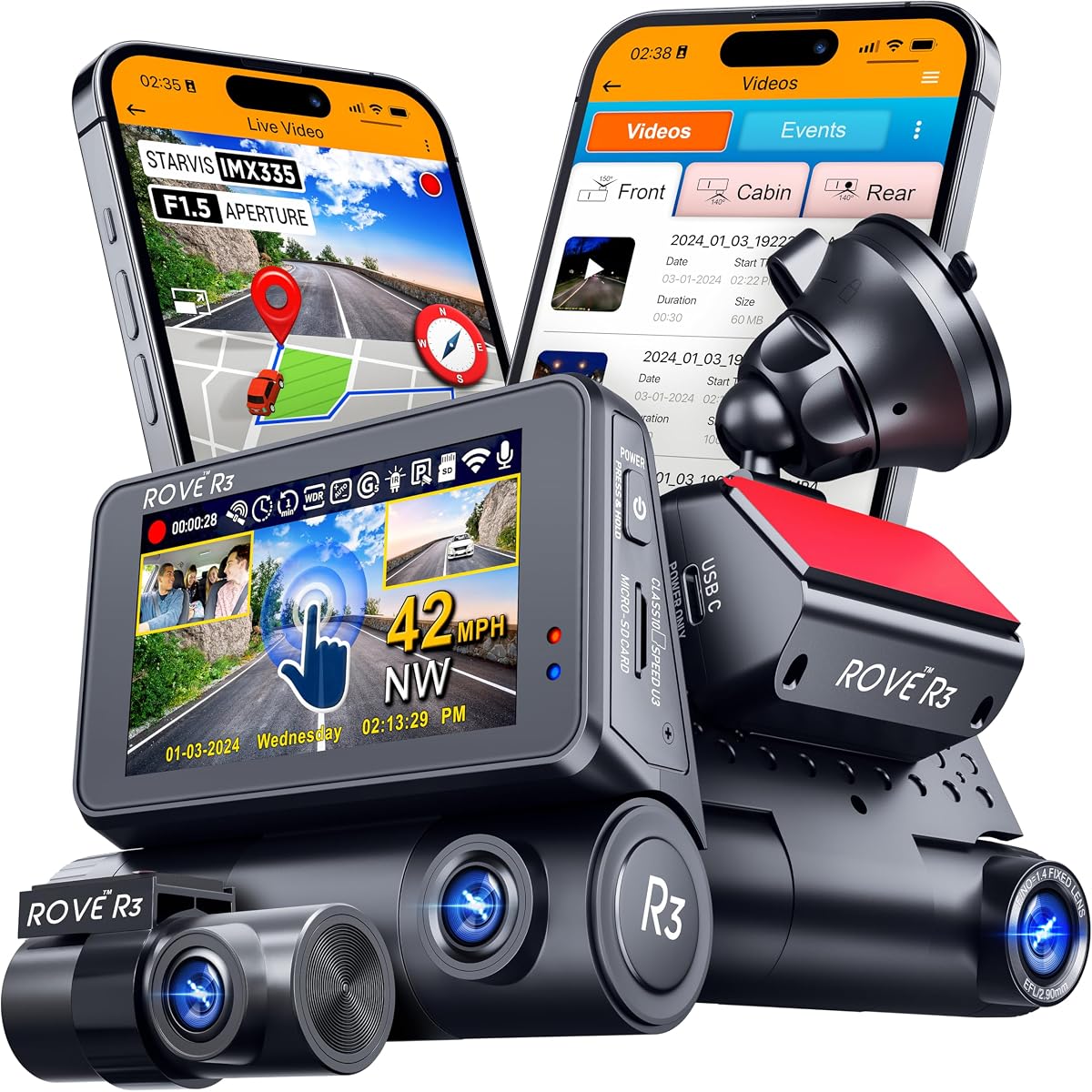
The ROVE R3 is the most complete three-channel ROVE system in the group, with a 4.4 rating and simultaneous front, cabin, and rear recording. Its 3-inch IPS touchscreen and streamlined single-button design make the camera more interactive than a conventional button-controlled dash cam. The front channel records at 2K, while the cabin and rear channels record at 1080p.
We may earn a commission when you buy through this link, at no additional cost to you.
The always-on dual-band WiFi supports transfer speeds up to 30 MB/s through the ROVE apps for iOS and Android. Built-in quad-mode GPS supplies live speed, compass, and location stamps, and the system supports over-the-air firmware updates. A supercapacitor is used for safety and longer service life, while digital image stabilization, wide dynamic range, and an F1.5 aperture support image quality.
The cabin camera is a major differentiator because four hidden infrared LEDs can illuminate the interior in complete darkness. This is valuable for rideshare drivers, families monitoring passengers, or anyone seeking evidence of events inside the vehicle. The system also offers parking monitoring, G-sensor protection, loop recording, time-lapse footage, a screen saver, and USB Type-C ports.
The R3 is the top ROVE recommendation for buyers who want one system to cover the road, passenger compartment, and rear window. It offers more control through its touchscreen and faster wireless transfers than the standard R2-4K. Its trade-offs are the lack of an included memory card and the greater storage demands of keeping three channels active.
Three synchronized channels provide a more complete account of a journey than a conventional front-and-rear setup. The cabin view documents passenger activity, while the rear camera records traffic and incidents behind the vehicle. For professional drivers, families, and anyone concerned with interior activity, this broader viewpoint can be more valuable than increasing the resolution of a single channel.
The 3-inch IPS touchscreen puts recording controls, system status, and playback options within reach. ROVE's single-button physical design reduces visual clutter, while the always-on 5GHz and 2.4GHz WiFi makes phone access convenient. Transfer speeds of up to 30 MB/s are particularly useful for the larger files produced by three active channels.
We may earn a commission when you buy through this link, at no additional cost to you.
The ROVE Ultimate Hardwire Kit is an accessory rather than a standalone camera, and it receives the highest rating in this roundup at 4.6. Its purpose is specific: providing continuous power to compatible ROVE dash cams so their 24-hour parking monitoring features can operate while the vehicle is parked. It is designed to connect to the vehicle's fuse box.
We may earn a commission when you buy through this link, at no additional cost to you.
Compatibility is listed for the R2-4K with a USB-C port, R2-4K PRO, R2-4K DUAL, R2-4K DUAL PRO, and R3 dash cam with USB Type-C. The kit includes necessary fuse taps, a volt meter, and related components. Because it connects directly to the vehicle's electrical system, it removes the need to keep a visible USB car charger connected during parking surveillance.
The main benefit is a cleaner installation. Instead of routing a charging cable to a front socket, the hardwire connection can be concealed within the vehicle trim, which looks more professional and avoids a loose cable near the windshield. A written manual and how-to videos are included to guide installation through the fuse-box process.
This kit is most appropriate for a ROVE owner who has selected a compatible camera and wants its parking mode to remain active after the engine stops. It does not record footage by itself and should not be treated as a substitute for a camera. Buyers who are uncomfortable with vehicle wiring should consider professional installation or a carefully selected compatible parking-mode accessory.
A dash cam connected only to the cigarette-lighter socket may stop receiving power when the vehicle is switched off. This hardwire kit draws power from the fuse box, allowing compatible ROVE cameras to keep using time-lapse, motion-detection, or collision-detection parking functions. Confirm compatibility before installation.
Routing the power into the vehicle trim removes the need for a permanently visible charging adapter. Fuse taps and a volt meter are included, and the provided instructions are intended to make the process accessible. Correct fuse selection, cable routing, and testing are important for a safe and reliable installation.
We may earn a commission when you buy through this link, at no additional cost to you.
The REDTIGER F7N TOUCH is a dual-camera alternative for shoppers comparing the ROVE R2-4K Dual with other front-and-rear systems. It has a 4.3 rating and combines a 4K front camera with a 1080p rear camera. The front uses a STARVIS 2 sensor and a 170-degree viewing angle, while the rear offers a 140-degree view.
We may earn a commission when you buy through this link, at no additional cost to you.
Its most distinctive feature is the combination of a touchscreen and hands-free voice commands. The screen can lock emergency footage, enable WiFi, and manage other functions, while physical buttons remain available. Built-in 5.8GHz WiFi supports app transfers at up to 20 MB/s, and the included REDTIGER Cam app provides preview, playback, sharing, and route information.
HDR, WDR, and Super Night Vision support better handling of low light and bright headlights. GPS records location, speed, and route, while the G-sensor locks footage following sudden movement or impact. Seamless loop recording overwrites older files as needed, and the included 128GB card allows use without buying storage separately.
Parking surveillance supports time-lapse and collision detection, but it requires a separate hardwire kit. The F7N TOUCH is a strong alternative for drivers who prioritize physical screen interaction and voice control in a two-camera package. It competes closely with the ROVE R2-4K Dual, but ROVE offers a rear supercapacitor-based design and built-in route display, while this model emphasizes touch and voice input.
The F7N TOUCH gives users several ways to operate the camera. Its smart touchscreen can lock important clips or change wireless settings with a tap, while voice commands help reduce physical interaction while driving. Conventional buttons remain present for situations when touch interaction is less convenient.
The 170-degree front lens captures a broad portion of the road, while the 140-degree rear lens covers traffic behind the vehicle. Combined with STARVIS 2 imaging, WDR, and HDR, this creates a useful setup for commuters and rideshare drivers. A 128GB card is included, making the initial setup more convenient.
We may earn a commission when you buy through this link, at no additional cost to you.
The REDTIGER F7NP is a two-camera dash cam with a 4.1 rating, making it a relevant alternative for drivers who prioritize a wide forward field of view and straightforward operation. It records 4K through the front camera and 1080p through the rear camera. A STARVIS 2 sensor, F1.5 aperture, and six-layer optical lens support its low-light performance.
We may earn a commission when you buy through this link, at no additional cost to you.
The 170-degree front angle is particularly broad, while the rear camera provides 140-degree coverage. HDR and WDR work together to balance highlights and shadows, helping the camera retain detail in difficult lighting. These characteristics make the F7NP suitable for commuters, road-trip drivers, rideshare operators, and new drivers who want a broad view without navigating a complex menu.
Built-in 5.8GHz WiFi enables app-based preview, download, playback, settings management, and sharing at speeds up to 20 MB/s. GPS data supplies route, speed, and location information. A free memory card is included, seamless loop recording manages storage, and the G-sensor protects event footage from being overwritten.
For parked protection, the camera offers time-lapse and G-sensor parking modes, but a hardwire kit is necessary. The supercapacitor design is also intended to support reliability and heat resistance. Buyers should note the lower rating and 1080p rear channel, but for those priorities, the F7NP delivers a capable and uncomplicated dual-camera package.
A 170-degree front field of view captures much of the roadway and nearby surroundings, reducing blind areas that appear around a narrower lens. The trade-off is that objects near the edges can look stretched or distorted, so the image should be evaluated for how its composition suits the driver's usual roads and vehicle.
The STARVIS 2 sensor, F1.5 aperture, WDR, and HDR work together to improve low-light balance. Built-in 5.8GHz WiFi supports relatively quick phone transfers, while GPS adds route and speed overlays. The included card and supercapacitor further improve readiness for regular use.
We may earn a commission when you buy through this link, at no additional cost to you.
The Garmin Dash Cam Mini 3 is a compact 1080p alternative for drivers who prioritize discretion over resolution. It has a 4.0 rating and uses a key-sized design intended to remain virtually unnoticed on the windshield. The camera automatically records and saves incident video with date and time information.
We may earn a commission when you buy through this link, at no additional cost to you.
Its 140-degree field of view is wide enough to capture substantial road context, and the built-in Garmin Clarity polarizer helps reduce windshield glare. Voice control can save video and start or stop audio recording in several supported languages. These features make the Mini 3 convenient for drivers who want a simple recorder that does not dominate the cabin.
The Garmin Drive app adds online Vault storage for important clips and supports remote viewing of up to four synchronized cameras. However, remote live view and parking notifications require a paid Vault subscription, active WiFi, constant power, and a compatible smartphone. Non-subscribers can still view and download files when close to the camera.
The Mini 3 is best for minimalists who accept 1080p footage in exchange for a very small footprint and ecosystem that can expand to several cameras. It is not the strongest match for a buyer seeking 4K detail, multiple bundled views, or unrestricted wireless access. Those priorities are better served by the ROVE R3, R2-4K Dual, or R2-4K Dual PRO.
The compact body is the Mini 3's defining advantage, reducing visual obstruction and making it less noticeable from outside the vehicle. Automatic operation reduces the need to remember manual start commands, while voice control offers a hands-free way to preserve a clip. The integrated polarizer helps maintain visibility through reflective windshields.
Garmin's Vault service can store important videos in the cloud and enable remote camera access when the necessary hardware, power, WiFi, and app conditions are met. Those features are useful for owners of multiple cameras, although the subscription requirement should be considered alongside the product's core 1080p recording function.
We may earn a commission when you buy through this link, at no additional cost to you.
The Vantrue N4 Pro S is a premium three-channel alternative with a 4.4 rating. It records front footage at 4K, cabin footage at 2.5K, and rear footage at 1080p, all at 30 frames per second. Triple STARVIS 2 sensors and HDR support image quality, while wide 155-degree, 160-degree, and 165-degree angles create broad coverage around the vehicle.
We may earn a commission when you buy through this link, at no additional cost to you.
The rear camera can rotate through 360 degrees, allowing it to monitor traffic or the trunk area depending on the chosen orientation. A front-and-rear mode records at 4K and 2.5K and is stated to reduce heat and power use compared with maintaining all three channels. This flexibility is helpful in warm climates or for drivers who do not always need a cabin view.
Parking mode uses buffered motion and impact detection to preserve footage from before an event. GPS records route, speed, and location, 5GHz WiFi supports phone transfers, and voice commands support hands-free operation. Loop recording can use one-, two-, or three-minute segments, while the supercapacitor is designed to tolerate temperature extremes. Storage capacity can reach 1TB, but no memory card is included.
The N4 Pro S is a strong choice for drivers who want more resolution than a conventional three-channel setup and value a flexible rear camera. It is especially interesting for professional drivers, families, and vehicles where interior coverage matters. Compared with the ROVE R3, it prioritizes 4K front detail and 2.5K cabin footage, while ROVE emphasizes the touchscreen and faster stated transfer rate.
Recording the cabin channel at 2.5K preserves more detail than the common 1080p interior channel, which can help when the subject is close to the camera. The 4K front and 1080p rear combination provides a balanced archive. Users can also disable the cabin channel to prioritize front-and-rear resolution and reduce heat.
The rotating rear camera can face toward the road or toward the vehicle's interior and trunk area, depending on mounting. Buffered parking mode retains several seconds before a detected event, increasing the chance that useful context is preserved. A compatible hardwire kit is required for continuous parking power.
We may earn a commission when you buy through this link, at no additional cost to you.
The REDTIGER F17 is a three-channel dash cam offering front, cabin, and rear coverage. It has a 4.4 rating and uses a STARVIS 2 IMX675 sensor in the front camera, which records at 4K. The cabin and rear cameras record at 1080p, with 150-degree, 160-degree, and 155-degree views respectively.
We may earn a commission when you buy through this link, at no additional cost to you.
WDR and HDR improve brightness, dynamic range, and low-light performance, while the STARVIS 2 pixel structure is designed to reduce noise and motion blur. Dual-band 5GHz and 2.4GHz WiFi provides app access, GPS supplies route and speed information, and the REDTIGER app can replay the three channels together. This is useful when reconstructing an incident from several angles.
Users can choose between three-channel recording and dual-channel configurations. Turning off the cabin camera enables 4K front and 1080p rear recording, while the listed 2.5K dual mode balances resolution and exposure. Parking protection offers time-lapse and collision-detection options, and a supercapacitor supports operation in changing temperatures.
The F17 is an appealing value-oriented alternative to the ROVE R3 for drivers who want three views but do not need a large touchscreen. A 64GB card is included, though capacity is lower than the storage bundles offered by some competitors. Parking mode still requires a hardwire kit, so budget for that accessory if continuous surveillance is a priority.
The ability to switch between three-channel and dual-channel recording helps balance coverage against storage use and heat. Drivers who mainly need a clear road view and rear record can use 4K plus 1080p, while those requiring interior evidence can retain all three perspectives. This makes the camera adaptable to changing daily needs.
Built-in 5GHz and 2.4GHz WiFi supports phone-based review through the REDTIGER app, while GPS adds route and speed data. The included card provides immediate recording capacity, and the three-channel replay helps show what happened from multiple directions. For parked coverage, the system requires an appropriate hardwire kit.
We may earn a commission when you buy through this link, at no additional cost to you.
The right ROVE dash cam depends on viewing direction, image quality, wireless workflow, storage needs, and whether parking surveillance is important. Review the technical specifications and installation requirements together rather than focusing on a single headline specification.
A front-only camera is the simplest option and places the emphasis on the road, traffic signals, and vehicles ahead. A dual-camera system adds a rear view, which can be valuable for following vehicles, parking incidents, or a complete account of a collision. Three-channel systems also record inside the cabin, making them especially useful for rideshare drivers, families, and anyone needing evidence of passenger activity. The ROVE R3 records the front at 2K and the cabin and rear at 1080p, while the Vantrue N4 Pro S raises the front to 4K and the cabin to 2.5K.
Choose the number of channels based on the viewpoints you actually need. More cameras improve situational awareness but create larger files, require more storage, and may produce more heat.
Resolution determines how much fine detail a camera can capture, but the image sensor, lens, aperture, HDR, and low-light processing are equally important. The ROVE R2-4K Dual records its front channel at 2.5K and upscales it to 4K, so it should not be compared directly with the R2-4K Dual PRO's native 3840 by 2160p output. A native 4K stream can preserve more original detail, particularly for distant plates and signs, but it also requires a more capable card and generates much larger files.
Pay attention to the difference between native and upscaled 4K. For maximum front-camera detail, favor a native 4K model, while considering the rear channel's resolution separately.
Night performance depends on more than a night-mode label. Sony STARVIS 2 sensors, wide apertures such as F1.5 or F1.7, HDR, WDR, multi-layer lenses, and infrared cabin lighting can each contribute. The ROVE R2-4K Dual and Dual PRO use STARVIS 2 sensors, while the ROVE R3 adds four hidden infrared LEDs for its cabin camera. Wide dynamic range is particularly helpful when headlights, tunnels, streetlights, and dark surroundings appear in the same scene.
For frequent nighttime driving, choose a camera with a modern low-light sensor and wide aperture. Interior coverage should also be checked for infrared illumination if passengers must be visible in darkness.
Dash cams rely on microSD cards because continuous recording quickly fills ordinary storage. The ROVE R2-4K Dual and R2-4K Dual PRO include 128GB ROVE PRO cards, the REDTIGER F17 includes a 64GB card, and the REDTIGER F7N TOUCH and F7NP include storage. The standard ROVE R2-4K and ROVE R3 do not include a card. Maximum supported capacities also vary, with some ROVE models supporting cards up to 1TB and the R2-4K and R3 supporting up to 512GB. High-resolution and three-channel use generally calls for a reliable U3 card.
Check the included storage, supported maximum, and required speed class together. Use a card suitable for continuous video recording and format it according to the camera instructions.
A phone app should make footage easy to find, download, share, and review. The ROVE R2-4K Dual supports transfers at up to 20 MB/s, while the R2-4K Dual PRO and R3 list speeds up to 30 MB/s. The basic R2-4K supports up to 6 MB/s, which is still sufficient for routine retrieval but may take longer for lengthy 4K files. Apps also commonly handle settings, firmware updates, GPS playback, and event locking. Consider whether you prefer a touchscreen, physical buttons, voice commands, or phone-based control.
Prioritize an app that matches your habits and a transfer rate suitable for your recording resolution. Faster transfer is most valuable when you routinely download several long clips.
Parking surveillance is not automatically available with every dash cam and often requires a hardwire kit. ROVE's listed parking options include time-lapse recording, motion detection, and collision detection, with triggered event files placed in a protected folder. A hardwire kit connects to the fuse box and supplies power after the engine stops. The ROVE Ultimate Hardwire Kit is compatible with several listed ROVE models, including the R2-4K Dual, R2-4K Dual PRO, and R3.
Verify camera and kit compatibility before buying. If you are uncomfortable with fuse-box installation, professional assistance may be worthwhile. Test the completed installation before relying on parking mode.
GPS can add route, location, speed, compass, and timestamp information to recordings, making footage easier to place along a journey. The ROVE R2-4K Dual and Dual PRO display live speed and compass data, and the R3 adds a touchscreen for system control. Installation quality also matters: clean the mounting surface, secure the cable, keep the lens unobstructed, and route wiring so it does not interfere with airbags or vehicle controls. USB Type-C, included chargers, trim tools, and mounting accessories can affect setup convenience.
Look for an installation process and controls that suit your comfort level. A clean mount, stable power connection, and unobstructed field of view are more valuable than a minor feature that you will not use.
Begin by confirming that the camera is compatible with the vehicle, the selected microSD card has sufficient capacity, and the kit includes the correct power connection. Format the card in the camera before its first use, clean the windshield or mounting area, and attach the camera where it does not block the driver's view. Route the rear-camera cable along the headliner or trim without crossing moving parts.
Power the unit with the supplied or manufacturer-approved cable and a compliant source, then test recording, playback, GPS, and phone connectivity while the vehicle is safely parked. Set the date, resolution, loop duration, and event-lock behavior in the app. Download a sample clip to confirm that video transfers correctly and that route and speed information appear when GPS is active.
For parking protection, install a compatible hardwire kit and test the parking modes before relying on them. Review clips regularly, back up important footage, and keep the storage card in good condition. Clean the lens gently, avoid high-temperature storage, inspect cables for damage, and replace a card that produces recording errors or corrupted files.
The ROVE R3 is the clearest ROVE option for cabin recording because it captures front, cabin, and rear channels simultaneously. Its four hidden infrared LEDs also support recording inside a dark vehicle. The Vantrue N4 Pro S is a strong alternative, but it is not a ROVE product and requires a separate memory card. For regular passenger monitoring, both systems provide substantially more context than a front-only camera.
No. The ROVE R2-4K Dual and R2-4K Dual PRO include 128GB ROVE PRO cards, while the standard ROVE R2-4K and R3 require separate storage. The R3 supports branded Class 10 or U3 cards up to 512GB. Check the current package contents and select a reliable card with enough capacity for your chosen recording channels and resolution.
The listed ROVE models support parking surveillance, but a compatible hardwire kit is required for continuous power after the vehicle is parked. The ROVE Ultimate Hardwire Kit is designed for several supported ROVE cameras. It connects to the vehicle's fuse box and helps hide wiring, although incorrect installation can affect vehicle operation, so careful installation or professional help is recommended.
No. The front camera records at 2.5K and upscales the image to 2160p for sharper everyday playback. The R2-4K Dual PRO records native 4K at 3840 by 2160 pixels. The distinction is important for buyers who want the highest level of original front-camera detail, while the standard Dual may still provide sufficient quality for routine evidence.
The amount depends on resolution, frame rate, bitrate, and the number of active channels. Native 4K recordings and three-camera systems consume considerably more space than 1080p single-channel footage. Choose a card within the camera's supported capacity and use a card appropriate for sustained video recording. Important event clips should be transferred or backed up before loop recording replaces them.
Yes. The camera records to its microSD card independently, and GPS, loop recording, and event locking continue to operate without a phone connection. WiFi is mainly used for viewing, downloading, managing settings, sharing, and accessing certain app functions. Connecting through the ROVE app makes incident review much easier.
A dual-band camera can operate on both 5GHz and 2.4GHz WiFi, while a single-band camera uses one of those ranges. The 5GHz band generally provides faster transfer in a suitable environment, which is valuable for large 4K files. Actual performance depends on the phone, distance, interference, camera placement, and surrounding network conditions.
That depends on the parking environment and local conditions. Supercapacitor-based ROVE models are designed to avoid the heat risks associated with many lithium batteries, but no device is immune to extreme heat. Do not leave a camera in direct sunlight on the dashboard for long periods, and follow the manufacturer's temperature and storage guidance.
The ROVE R2-4K Dual is the most balanced starting point, combining front-and-rear recording, a STARVIS 2 sensor, built-in GPS, fast dual-band WiFi, and an included 128GB card. The ROVE R3 stands out for its polished touchscreen and three-channel coverage, while the R2-4K Dual PRO delivers the most advanced ROVE two-camera image configuration with native 4K front video, 2K rear video, and a circular polarizing filter.
Prioritize the number of viewpoints first, then consider low-light performance, storage requirements, app convenience, and parking mode. A single camera may be sufficient for straightforward road recording, but dual and three-channel systems are more valuable when a driver needs rear or passenger context. Choose compatible storage and a hardwire kit if parked surveillance is important.
Product listings, package contents, ratings, and promotional details can change, so verify the current specifications and compatibility before purchasing. Compare the current listing with the priorities in this guide rather than relying on a model name or resolution headline alone. The right ROVE Dash CAM is the one that captures the views you need and remains manageable to operate every day.