10 Best 3D Printer Enclosure For ABS Printing in 2026
Our 3D printer enclosure for ABS printing guide compares ten options for temperature control, ventilation, safety, noise reduction, compatibility, and print
As an Amazon Associate we earn from qualifying purchases. We may earn a commission when you buy through links on this page, at no additional cost to you.As an Amazon Associate we earn from qualifying purchases.Purchases through our links may earn us a commission, at no extra cost to you.
ABS printing often reveals weaknesses that PLA users may never notice. Warping, layer separation, and cracking can become common when the chamber loses heat, while fumes also demand careful attention. A suitable enclosure creates a more stable environment and helps contain odors, but printer fit, ventilation, and temperature control must work together to deliver useful results.
This guide compares ten enclosures using the information supplied for each product. We examine dimensions, intended printer compatibility, insulation, ventilation and filtration, visibility, safety features, noise reduction, installation, and relevance to ABS or other high-temperature filaments. The list includes model-specific covers, general-purpose tents, and larger multi-printer cabins rather than treating every enclosure as interchangeable.
Each review identifies the product's strongest benefits and practical compromises, while three overall picks highlight the most compelling combinations of features. The rankings reflect the supplied ratings and product information, not personal testing. Product availability, design details, and prices can change, so readers should verify the current listing and measure their printer before making a final purchase.
Top 3 Picks for Best 3D Printer Enclosure for ABS Printing
Best Budget
3D Printer Enclosure with Ventilation Kit & LED Lighting – Thermal Insulation Cover & Fume Extraction Tent for FDM/DLP/SLA/LCD 3D Printers (Size 700 x 750 x 900mm)
3D Printer Enclosure with Ventilation Kit – Thermal Insulation Cover & Fume Extraction Tent for FDM/DLP, SLA/LCD 3D Printers (Size 800 x 1000 x 1200mm)
Top 10 Best 3D Printer Enclosure for ABS Printing in 2026 Compared
The comparison below highlights the enclosure size, printer focus, temperature and odor-control features, and practical trade-offs of all ten products, helping readers identify the right format for their ABS-printing setup.
This 800 x 1000 x 1200mm enclosure has a 4.8 rating, the highest among the listed products, and presents the most versatile general-purpose enclosure design. Its size makes it relevant to ABS printing because it can surround a large FDM machine, while also leaving room for resin printers, wash-and-cure stations, or several compact printers. A fully enclosed structure is especially useful when consistent chamber warmth is the priority.
Pros
Very large working capacity
Strong thermal enclosure concept
Flexible printer positioning
Useful viewing window
Supports multiple printer styles
Cons
Ventilation kit sold separately
Requires substantial space
We may earn a commission when you buy through this link, at no additional cost to you.
The enclosure uses waterproof fabric, sealed openings, and air-tight zippers to contain odors before they spread through a room. Two ports are provided for a four-inch exhaust fan, allowing fumes and smoke to be directed out of the enclosure. The supplied information specifically notes that the ventilation kit is not included, so buyers must add a compatible system separately. That arrangement gives serious users more control over the placement and direction of exhaust equipment.
Thermal insulation is a central feature, helping maintain a warm ambient temperature that can reduce ABS bed warping, layer cracking, and nozzle clogging. A dark transparent window serves as an observation area and UV filter, while a light bar makes print monitoring easier. The trade-offs are physical size and setup effort: the product is enormous, assembly is described as taking 15 to 20 minutes, and a friend may be needed. It also demands sufficient countertop and room space.
This is the strongest choice for a user who wants room to grow, operates more than one printer, or already has large-format equipment. It is less suitable for a small desk or a single compact printer. For a serious ABS workspace with enough space and a willingness to configure exhaust separately, it offers the most complete combination of capacity, insulation, access, and printing-environment control in this roundup.
Room To Run Large ABS Machines
The oversized interior accommodates large FDM printers such as the listed CR-series and Kobra Max examples. It also provides a side opening for multiple smaller machines, making the enclosure useful as a shared production area rather than a simple cover.
Controlled Odor Containment
Sealed zippers and dedicated exhaust ports help contain ABS fumes before they move into the surrounding room. Because the fan kit is separate, users can select the exhaust arrangement that best suits their ventilation setup.
The YOOPAI enclosure has a 4.4 rating and is a practical choice for Creality Ender 3 owners seeking stable conditions, integrated monitoring, and a straightforward setup. It combines an enclosure, ventilation kit, and LED light, making it a more complete package than a basic fabric tent. Its enclosed form is well suited to ABS because reducing drafts and external temperature swings can improve first-layer consistency.
Pros
Accessible general-purpose option
Useful environmental monitoring
Quick and tool-free setup
Integrated light improves visibility
Wide listed printer support
Cons
Ender 3 dimensions must be checked
No detailed airflow specifications
We may earn a commission when you buy through this link, at no additional cost to you.
A built-in monitoring system displays real-time temperature and humidity, allowing the operator to judge whether the chamber is actually maintaining a stable environment. That information is more useful than enclosure claims alone because material behavior changes with humidity and temperature. The LED strip illuminates the build area, helping users identify filament jams, adhesion problems, or misalignments without opening the enclosure and disturbing the chamber.
The manufacturer describes the material as dustproof and fireproof, while the full enclosure helps reduce transmission of fan and motor noise. Installation is advertised as taking about five minutes, and the structure can be disassembled for relocation. Compatibility extends across numerous Ender 3 variants and other named FDM printers, but the stated supported size is smaller than 21.6 inches wide, 25.6 inches deep, and 29.5 inches high, including the spool holder.
The principal compromise is that users must measure the complete printer, including accessories, before ordering. Detailed fan capacity and exhaust performance are not supplied, so the ventilation kit should be evaluated as part of the overall package rather than assumed to provide laboratory-grade extraction. For Ender 3 users who want monitoring, lighting, insulation, and a low-friction installation in one enclosure, it remains a well-balanced pick.
Monitoring The Printing Environment
Real-time temperature and humidity readings make it easier to determine whether conditions remain suitable for ABS. This visibility can help users distinguish printer problems from enclosure or ambient-temperature problems.
Useful Visibility And Access
The integrated LED strip brightens the print chamber, while the enclosure limits accidental contact with moving and heated components. A clear view helps users respond to visible defects without routinely breaking the enclosed environment.
This large enclosure shares the same 4.8 rating and broad specification profile as the top overall model, functioning as a spacious production shelter rather than a lightweight printer cover. Its 31.5-inch width, 39.4-inch depth, and 47.2-inch height are substantial, but that scale is what allows it to accommodate a large ABS printer or a combination of FDM and resin equipment.
Pros
Highest product rating
Accommodates large equipment
Sealed odor containment
Flexible dual exhaust routing
Supports multiple workflows
Cons
Exceptional footprint requirement
Ventilation hardware not included
We may earn a commission when you buy through this link, at no additional cost to you.
Dual-side opening is one of its most useful design choices. The front opening supports large printer examples, while the side opening can hold two to four small FDM printers, resin printers, or wash-and-cure machines. That flexibility makes the enclosure attractive for hobbyists running mixed materials or workshops that want to centralize equipment. The dark transparent window filters UV light while still providing a view of the print process.
The product description emphasizes a specialized warming layer intended to support a stable ambient temperature. For ABS, that focus is relevant because temperature loss can contribute to warping, cracking, and inconsistent layer bonding. At the same time, waterproof fabric, sealed zippers, and ports for a four-inch fan help contain fumes. The primary disadvantage is that the ventilation kit must be ordered separately, adding another component and setup decision to an already large structure.
Buyers should ensure that their desk is at least 800 by 1200mm and that the surrounding room can accommodate the enclosure's depth and access needs. It is best suited to users who value capacity and a controlled environment more than compactness. For a dedicated ABS printing station, this model can provide the kind of stable, enclosed working area that smaller tents struggle to provide.
A Dedicated Multi-Device Workspace
The separate side and front openings make it possible to organize large and small machines within one enclosure. Users can position printers according to access needs and route the exhaust toward a suitable outlet.
Better Conditions For ABS
The warming layer and sealed structure help shield the print chamber from cold ambient conditions. This can reduce common ABS symptoms such as warping and layer cracking when combined with appropriate printer settings and proper bed preparation.
The TOPCUBE enclosure has a 4.4 rating and is designed specifically for a Bambu Lab A1 equipped with AMS Lite. Its 580 x 670 x 670mm dimensions are tailored to that configuration, giving model-specific buyers a more confident fit than a generic enclosure. For ABS printing, the enclosed design supports a stable temperature and humidity environment that can reduce warping and breakage.
Pros
Tailored A1 compatibility
AMS Lite dimensions considered
Visible real-time print area
Reported strong noise reduction
Quick installation
Cons
Limited to A1-focused fit
AMS Lite is necessary
We may earn a commission when you buy through this link, at no additional cost to you.
A particularly useful claim is that internal temperature will not exceed 40°C during use after long-term testing. That distinction matters for ABS because an enclosure should retain warmth without becoming an uncontrolled heat source. The large transparent observation window and integrated LED allow users to monitor progress in real time, while the full enclosure helps reduce dust entry and noise transmission.
The listed noise reduction is from 60 decibels to 40 decibels, which is one of the stronger quantified claims in the roundup. The fire-resistant material and robust structure also serve safety and durability goals, while installation is advertised as taking five minutes. Its narrow specialization is the main drawback: the listing specifically warns users of other printer models to verify dimensions carefully.
This is a strong choice for a Bambu Lab A1 Combo owner whose regular materials include ABS, PLA, or TPU. It is not the right option for a mixed-printer workshop or someone without AMS Lite. Its advantage lies in the focused fit, controlled temperature claim, convenient monitoring, and substantial noise isolation rather than in a broad range of interchangeable configurations.
Purpose-Built A1 Dimensions
The enclosure was designed around a Bambu Lab A1 with AMS Lite, reducing the uncertainty associated with fitting a universal cover. Owners of other printers should measure carefully because the dimensions are not interchangeable.
Controlled Heat And Lower Noise
A stated internal ceiling below 40°C supports a stable chamber without the product relying on extreme heat. The fully enclosed structure also provides a substantial reduction in transmitted printer noise.
This 700 x 750 x 900mm enclosure has a 4.4 rating and stands out as the most complete premium package in the list. It includes the insulated tent, stainless steel shelf, a pre-tested 180 CFM fan, a three-meter exhaust duct, a backdraft valve, and an LED lighting bar. Buyers do not have to assemble a separate ventilation system before putting the enclosure to work.
Pros
Complete included ventilation kit
Strong thermal insulation
High-capacity exhaust hardware
Generous interior space
Flexible hose placement
Cons
Large footprint and height
Some printer exclusions apply
We may earn a commission when you buy through this link, at no additional cost to you.
For ABS printing, the built-in insulation is designed to raise internal temperature by 5°C to 15°C. A warmer, steadier chamber can help limit warping, layer separation, and nozzle clogs, while airtight zippers, EVA gaskets, and screw-secured ports improve containment. The exhaust system is described as refreshing air ten times per minute, which is a more concrete claim than simple odor isolation and is especially relevant to strong ABS emissions.
The included shelf keeps the printer elevated, and the light bar improves visibility inside the chamber. Dual exhaust ports allow the hose to run left or right, useful when room layout determines the best exhaust route. The product also claims passive humidity reduction over long-term use, but this should be understood as a potential environmental benefit rather than a substitute for controlling damp filament or a sealed dry box.
The main limitation is size. It fits FDM printers under the stated external dimensions and resin printers with a screen no larger than 15.6 inches, but it is explicitly not suitable for Y-axis mechanisms of 370mm or more or screens larger than 23.8 inches. For a serious ABS workspace that wants substantial insulation and professional-style extraction, the comprehensive included kit justifies its place as the premium pick.
A Complete Air-Management System
The supplied fan, duct, backdraft valve, gaskets, and dual ports form a more complete ventilation arrangement than a basic enclosure with an opening. This makes the package particularly appealing for ABS users who want containment and directed extraction.
Insulation For Warping Control
The claimed 5°C to 15°C temperature increase helps protect prints from cold-room conditions. Stable warmth can reduce layer separation and bed adhesion problems, although enclosure benefits still depend on filament drying, bed preparation, and slicer settings.
The FLASHFORGE AD5M enclosure has a 4.3 rating and is explicitly designed for high-temperature materials such as ABS and ASA. Its central benefit is straightforward: maintaining a constant internal temperature helps the printer create a more stable environment for demanding filaments. PC support is also mentioned in the product title, making it relevant to users who print with several engineering thermoplastics.
Pros
Direct high-temperature filament focus
Personalized exterior design
Dust protection built in
Enclosed noise reduction
Simple model-specific fit
Cons
Specific to AD5M hardware
No detailed ventilation figures
We may earn a commission when you buy through this link, at no additional cost to you.
Unlike many utilitarian tents, this enclosure can be personalized in exterior color and material. That makes it easier to integrate with a home office, classroom, or workshop rather than treating the enclosure as purely functional equipment. The fully enclosed cover also blocks external dust, helps isolate odors, and reduces the transmission of printer noise. It can additionally keep children and pets from contacting hot components or moving machinery.
There is less technical detail about the frame, dimensions, airflow, and thermal performance than for the largest general-purpose enclosures. Consequently, it is harder to assess the exact degree of insulation or whether it includes a dedicated fan. The model-specific construction is convenient for an AD5M owner, but it offers little advantage to someone using another printer and may not accommodate spool holders or other tall accessories.
This cover is most appropriate for an AD5M user who values a close-fitting, customizable enclosure and prints ABS, ASA, or PC regularly. It should be considered a model-specific environmental accessory rather than a complete industrial ventilation system. Its combination of temperature retention, dust protection, odor isolation, and noise reduction makes it a practical option for dedicated high-temperature filament work.
Designed Around High-Temperature Filaments
Maintaining a consistent internal temperature is especially important when ABS or ASA cools unevenly between deposited layers. The enclosure reduces external temperature swings that can contribute to cracking and poor first-layer adhesion.
A More Personalized Workstation
Customizable exterior color and material allow the cover to fit a preferred workspace aesthetic. This does not change the core function, but it can make a permanent printing station feel less utilitarian.
The FLASHFORGE Adventurer 5M enclosure has a 4.2 rating and is a model-specific cover aimed at users printing demanding materials such as ABS, ASA, and PC. Its enclosed design optimizes heat dissipation to maintain a stable internal temperature, a relevant feature for reducing temperature-related stress and adhesion problems during high-temperature prints.
Pros
Focused high-temperature support
Customizable DIY appearance
Quantified noise improvement
Adds child and pet barrier
Dust protection included
Cons
Specific Adventurer 5M fit
Limited technical airflow detail
We may earn a commission when you buy through this link, at no additional cost to you.
Noise reduction is specified from 65 decibels to 55 decibels, giving shoppers a more measurable indication of the acoustic benefit than many competing listings provide. The enclosure also protects internal components from dust, blocks odors from escaping as freely, and creates a physical barrier against accidental contact by children or pets. These benefits make it more than a simple temperature shield.
The DIY design allows the exterior color to be customized, offering visual flexibility for a dedicated printer station. The drawback is that the product is tied to the Adventurer 5M rather than being a broad universal tent. The supplied information does not provide detailed dimensions, fan specifications, or filtration performance, so buyers seeking strong, measured exhaust capability should investigate those points before purchase.
For an Adventurer 5M owner who regularly prints ABS and values a quieter, cleaner, and safer machine area, the kit addresses several common needs at once. It is less compelling for printers outside its intended fit and for workshops that require a formally specified extraction rate. Within its model-specific category, it provides a thoughtful balance of heat retention, safety, and noise control.
A Quieter Printing Environment
The claimed reduction from 65 decibels to 55 decibels can make a printer easier to operate in a shared room. The enclosure also isolates internal parts from dust that could otherwise settle on moving components or the build surface.
Safer High-Temperature Printing
Stable heat supports ABS, ASA, and PC workflows, while the physical cover helps prevent accidental contact with hot parts. It does not replace safe filament handling or ventilation, but it adds useful layers of separation.
This 825 x 585 x 585mm enclosure has a 4.4 rating and is designed for a Bambu Lab A1 fitted with AMS Lite. The listing gives a particular warning about this requirement: owners without AMS Lite should not order, because an external top-mounted spool can make the printer too tall for the enclosure. That specificity makes dimension checking essential.
Pros
Sized for A1 AMS Lite
Active smoke and dust ventilation
Bright internal visibility
Fire-resistant and dust-resistant
Maintains constant temperature
Cons
AMS Lite requirement is restrictive
Only one specific printer family
We may earn a commission when you buy through this link, at no additional cost to you.
The enclosure includes an 8025 fan for removing smoke and dust during printing. For ABS users, active ventilation is important because odor isolation alone does not remove emissions from the room. The listing also describes fire-resistant and dust-resistant materials, a built-in LED system, and a structure intended to maintain a consistent printing temperature. Together, these features address comfort, visibility, cleanliness, and thermal stability.
The design is best understood as a focused A1 workstation rather than a general tent. It does not offer the broad printer compatibility or dual-side access of the largest products, and its supplied information provides fewer details about airflow rate and filter performance. Its advantage is that the known printer configuration allows the manufacturer to size the chamber around a specific external spool and AMS arrangement.
This enclosure makes the most sense for a Bambu Lab A1 Combo owner who prints ABS regularly and wants both temperature retention and active extraction. The LED improves monitoring, while the fan and sealed structure help manage fumes. Buyers without AMS Lite, or those who may change printers, should choose a more general enclosure instead of assuming the listed dimensions will be suitable.
Active Ventilation For Fumes
The included 8025 fan can move smoke and dust out of the chamber rather than merely trapping them. Users still need to route the enclosure safely and confirm that fumes do not recirculate into occupied space.
Built Around The A1 Combo
The dimensions are designed around the A1 and AMS Lite combination, including the height of an external spool. This specificity improves convenience for matching owners but excludes many other systems.
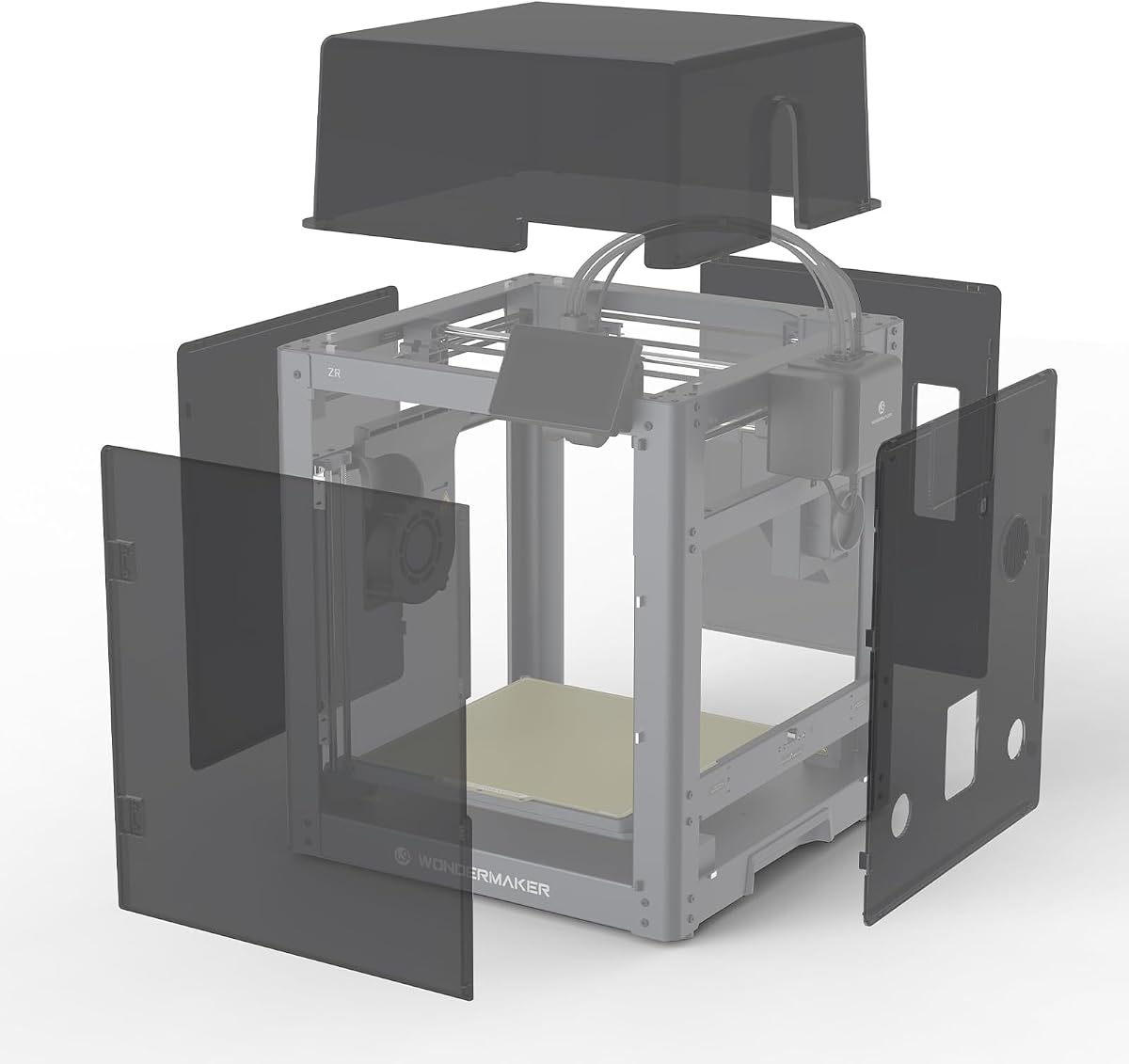
The SainSmart x WonderMaker ZR enclosure has a 4.5 rating and combines a custom-fit cover, active filtration, temperature retention, and quiet operation. Its built-in fan and replaceable filter module are especially relevant to ABS printing because they actively remove odors and fine airborne particles rather than relying only on an enclosed shell.
Pros
Active built-in air filtration
Replaceable filter module
Custom-fit convenient access
Supports ABS and ASA
Very quiet operating design
Cons
Limited to WonderMaker ZR
Requires filter replacement upkeep
We may earn a commission when you buy through this link, at no additional cost to you.
The design is intended to maintain consistent heat for ABS, ASA, PETG-CF, and other temperature-sensitive filaments. That stable environment can help prevent warping and cracking, while the filtered circulation keeps the surrounding workspace cleaner. The product claims noise reduction from 50 decibels to 48 decibels, reaching as low as 46 decibels in Silent Mode, which is a notably low stated operating level.
A magnetic top cover and front door allow convenient access without special tools, making the enclosure easier to use during setup, inspection, and maintenance. The custom fit also simplifies printer placement. The trade-offs are model specialization and ongoing upkeep: the kit is made for the WonderMaker ZR, and its replaceable filtration system will need appropriate replacement media and occasional cleaning.
For a ZR owner who prints high-performance filaments in a home studio, classroom, or workshop, this is a particularly cohesive solution. It addresses the two recurring objections to enclosure use—space and fumes—in a single integrated design. It is not suitable as a universal cover, and filtration should be treated as an additional safeguard rather than a guarantee that all emissions are eliminated.
Built-In Filtered Circulation
The high-efficiency fan and replaceable module actively draw air through the filtration system. This makes the enclosure more suitable for shared indoor spaces where odor and fine particles need active management.
Convenient Custom-Fit Access
Magnetic panels allow the user to open the top or front without tools. A precise fit preserves the enclosed design while making print monitoring and machine access more convenient.
The Sovol SV08 open enclosure has a 4.1 rating and takes a different approach from the fabric tents. Its metal and tempered glass construction creates a rigid, durable housing designed to reduce fan and motor noise while protecting an ongoing print from dust and external interference. For a high-speed SV08 owner, it provides a permanent workstation structure rather than a lightweight seasonal cover.
Pros
Rigid metal and glass build
Open design preserves access
Built-in dust screen
Exhaust fan aids odor removal
Supports temperature-sensitive materials
Cons
Open design is less insulated
Restricted to Sovol SV08
We may earn a commission when you buy through this link, at no additional cost to you.
The enclosure is designed to retain ambient heat, which can reduce warping and lifting when printing temperature-sensitive materials. It also includes a dust screen and exhaust fan to help limit odors associated with ABS, PETG, and nylon. The open configuration makes the machine easier to inspect and access than a fully tented system, although it will generally provide less passive insulation than a sealed fabric enclosure.
A separate Sovol website download is available for an SV08 top extension kit supporting a 345mm Z-axis printing size. That extension is also described as helping dissipate heat when printing PLA. Compatibility is otherwise very specific, so buyers must confirm that the enclosure matches their SV08 configuration and intended build volume. The rigid material may also add weight and require more careful handling than a fabric tent.
This enclosure is best for a Sovol SV08 user who values a durable, accessible structure and uses the printer in a space where noise, dust, and odor control matter. It is a weaker fit for someone seeking maximum chamber heat retention, since the open design and metal frame differ from insulated fabric construction. Its main appeal is the combination of rigidity, visibility, and machine-specific integration.
A Rigid Long-Term Structure
Metal framing and tempered glass provide a more permanent housing than a folding fabric tent. This design is appealing for users who want a consistent printer station that can be accessed easily.
Heat Retention Without Full Sealing
The enclosure is designed to keep heat stable and limit warping and lifting. Its open form balances that benefit with easier visibility and access, making it a practical middle ground for the SV08.
We may earn a commission when you buy through this link, at no additional cost to you.
Buying Guide – How to Choose the Best 3D Printer Enclosure for ABS Printing
Choosing an ABS enclosure means balancing heat retention, fume control, printer fit, access, and safety. The best enclosure is not simply the largest or most insulated one; it should match the machine, work area, filament workflow, and ventilation requirements.
Printer And Accessory Dimensions
Measure the printer's full width, depth, and height, including the spool holder, AMS, external spool, feet, and clearance needed to open the machine. Model-specific enclosures offer a more predictable fit, while general-purpose tents vary substantially in usable space. For ABS, do not assume a printer that physically fits will have enough room around the bed and filament path. Check whether the enclosure requires a particular orientation and whether front or side access remains possible during unloading.
Prioritize the complete footprint, not just the listed printer model. Measure the intended enclosure and leave room for the duct, door opening, and ventilation equipment.
Thermal Stability And Insulation
ABS benefits from a chamber that resists drafts and rapid temperature changes. Look for an enclosed design, insulating fabric or panels, sealed openings, and evidence of temperature consistency. A modest internal temperature increase can reduce bed warping, layer cracking, and nozzle clogging, but excessive heat can also create equipment concerns. Enclosures designed specifically for high-temperature polymers deserve particular attention, and any temperature claim should be considered alongside the printer's own specifications.
Choose insulation that retains heat without forcing constant high-heat operation. A stable ambient environment is generally more useful than an enclosure that becomes excessively hot.
Ventilation And Odor Control
ABS printing produces emissions that should not simply be trapped indoors. A good enclosure needs a controlled route for fresh air in and exhausted air out, or an active filtration system designed for printer fumes. Check whether a fan, duct, backdraft valve, gaskets, and filter are included. Sealed ports prevent leakage around an exhaust hose, while adjustable fan speed or replaceable filters make long-term maintenance more practical.
Treat odor reduction as one layer of safety. Use the enclosure in a well-ventilated room, follow the filament manufacturer's guidance, and never treat an enclosure as a substitute for a suitable exhaust path.
Size And Workspace Efficiency
Large enclosures can accommodate multiple machines, wash-and-cure stations, filament storage, and easier access, but they require more floor space, assembly effort, and suitable ventilation routing. Small covers are easier to manage and may suit one printer, though a tight fit can limit access or fail to include a tall spool holder. Consider the room, desk, doorway, and nearby furniture before choosing an oversized structure.
Choose the smallest enclosure that comfortably supports the printer and the tasks performed inside it. Extra space is useful only when it does not interfere with the rest of the workshop.
Visibility And Lighting
A transparent or dark transparent window allows users to monitor layers, nozzle movement, and visible defects. Integrated LED lighting is particularly helpful because many enclosures create a shadowed interior. For resin-oriented covers, a UV-filtering window serves an additional purpose by reducing ambient ultraviolet exposure. The viewing panel should still provide a clear enough image to identify a lifted edge, failed layer, or filament problem without repeatedly opening the enclosure.
Prioritize a large window and adequate internal illumination if you regularly inspect prints or need convenient access to the build plate.
Safety And Material Durability
Fire-resistant and dust-resistant materials can provide useful protection around a hot printer, and a full enclosure creates a physical barrier against children and pets. Neither feature eliminates the need to operate the machine safely, keep filament away from heat, and maintain electrical equipment correctly. Check the construction for sturdy supports, secure zippers or panels, and clear access to the printer's controls. Rigid metal and glass may be durable, while fabric tents need support to avoid collapsing inward.
Choose materials and construction that match the location. A permanent workshop enclosure can prioritize rigidity, while a compact home setup may benefit more from portability and easy disassembly.
Noise Reduction And Workflow Impact
An enclosure can reduce the transmission of fan, stepper, and motor noise, which matters in a home office or shared room. Look for a fully enclosed structure and quantified reductions when available. Noise isolation is particularly noticeable when the printer is otherwise quiet. However, active ventilation adds its own sound, and the result depends on fan speed, duct routing, printer settings, and the surfaces surrounding the machine.
Consider the complete system rather than the cover alone. A quieter printer paired with a loud exhaust fan may not deliver the expected acoustic improvement in every installation.
Installation And Maintenance
Some covers install in about five minutes, while very large fabric enclosures may take 15 to 20 minutes and require a second person. Frequent access to the bed, spool, or controls can make quick installation important. Active filtration also requires periodic filter replacement and dust cleaning, whereas a simple tent mainly needs surface upkeep. Confirm whether tools are required and how the enclosure can be disassembled for relocation or storage.
Select a design you will actually maintain. An enclosure that is difficult to open, clean, or vent may be used less consistently than a simpler setup.
How to Use and Care for Your 3D Printer Enclosure for ABS Printing
Before installation, measure the printer and the complete enclosure footprint, then confirm that the door, spool holder, filament path, control display, and exhaust hose remain accessible. Assemble the frame and fabric panels in a clear area, following the supplied instructions. Place the printer on a stable, level surface with adequate clearance, and connect any lighting, monitoring, or ventilation components before adding filament or beginning a print.
For ABS, dry the filament according to the material supplier's instructions, prepare the build plate, and make sure the nozzle is suitable for the chosen temperature. Allow the enclosure to stabilize before starting a long print, particularly after opening it in a cool room. Position any exhaust duct toward safe outdoor or building ventilation, secure connections, and avoid recirculating fumes into the same space. Monitor temperature and humidity when the enclosure provides readings, but use the printer's own controls and slicer settings as the primary source of truth.
Clean the interior gently and regularly, removing dust without disturbing heated surfaces or electronics. Inspect zippers, seals, panels, and filter housings for gaps or damage. If the enclosure includes a replaceable filter, follow its replacement schedule and avoid washing saturated media unless the manufacturer explicitly permits it. Keep the exterior dry, use compatible cleaning agents, and never block ventilation ports. Periodically verify that the printer still fits, that the spool feeds freely, and that the chamber can reach and maintain suitable ABS printing conditions.
Frequently Asked Questions
Do I need an enclosure to print ABS?
An enclosure is not absolutely required for every ABS print, but it can reduce drafts, temperature swings, dust, and odor spread. The benefit is greatest in a cool or drafty room and when first-layer adhesion or layer bonding is inconsistent. Proper bed preparation, dry filament, suitable temperatures, and enclosed machines with reliable chamber heating remain essential. An enclosure improves the environment around the printer but cannot compensate for poor slicer settings or unsuitable hardware.
Will a 3D printer enclosure make ABS warping disappear?
No enclosure can guarantee that ABS warping will disappear. A stable chamber can reduce one common cause by limiting rapid temperature changes, but warped parts may still result from an uneven build surface, inadequate adhesion, excessive cooling, contaminated plates, or wrong first-layer settings. Use the enclosure alongside a clean and level bed, suitable material settings, and appropriate preparation methods. Confirm that the printer is rated for the temperature required by the filament.
Should an ABS enclosure have ventilation or a filter?
Ventilation is generally important because an enclosure should not become a permanent container for fumes. The best setup combines controlled exhaust with sealing around the duct, while some models also use replaceable activated filtration. A filter can reduce odors and certain airborne particles, but it does not make unsafe exposure impossible. Place the printer in a well-ventilated area and follow safety guidance for the filament and exhaust equipment.
Is a larger 3D printer enclosure always better for ABS?
No. A larger enclosure offers room for accessories, multiple machines, better access, and easier exhaust routing, but it also takes more space and may be harder to install. A smaller, well-insulated enclosure can be sufficient for one printer if it fits the machine, spool, and ventilation equipment. The best choice depends on available workspace and production needs rather than size alone.
Do model-specific enclosures work better than universal tents?
A model-specific enclosure is usually easier to position and can account for features such as an AMS or external spool. It may also offer a tighter, more practical layout than a general tent. Universal enclosures are preferable when printers will change or when one chamber must support several devices. In either case, measure the entire printer and accessories, since compatibility lists do not always account for every optional component.
How hot should an ABS printing enclosure become?
The enclosure should maintain a reasonably stable temperature, but there is no universal target for every printer and room. A modest rise above ambient temperature can be useful in a cold space, while excessive heat may create safety or component concerns. Follow the printer and filament manufacturers' guidance, monitor the enclosure if sensors are available, and ensure the machine is designed for the chamber temperatures required by ABS.
Can I dry ABS filament inside a 3D printer enclosure?
Only if the printer, enclosure, and filament manufacturer explicitly support that workflow. Many consumer printers do not have a dedicated heated filament chamber, and ordinary bed or chamber heating is not automatically equivalent to a proper filament dryer. Using a separate dry box inside the enclosure may be possible, provided ventilation, heat, and electrical safety are addressed. Follow the filament supplier's recommended drying temperature and duration.
Will an enclosure reduce noise and odors from ABS printing?
It can reduce sound transmission because the fabric or rigid panels absorb and block some fan and motor noise. Odor performance depends more on whether the enclosure truly seals and how exhaust is routed. A closed shell without an exit path may trap fumes, while a controlled exhaust system can remove them more effectively. Model-specific noise claims and measured exhaust specifications are useful comparison points, but actual results vary with installation.
Final Thoughts on Choosing the Best 3D Printer Enclosure for ABS Printing
The large multi-printer enclosure earns the overall position because its high rating, generous dimensions, dual access, insulation, viewing window, and exhaust-port design cover many ABS-printing needs. The 700 x 750 x 900mm model is the premium choice for buyers who want the fan, duct, backdraft valve, shelf, and lighting included. For Ender 3 users, the YOOPAI enclosure offers an accessible, monitored, and quickly installed alternative.
The most important priorities are correct fit, stable heat, and responsible fume management. Model-specific covers such as the TOPCUBE, FLASHFORGE, Bambu Lab A1, WonderMaker ZR, and Sovol options make sense when the listed printer and accessories match. Larger tents are better for big machines or multiple printers, but their footprint and separate ventilation hardware must be considered before buying.
Finally, confirm the current product listing, dimensions, included accessories, compatibility notes, and current price before ordering. Product designs and availability can change, and a listing may be updated after this guide was prepared. Measuring the printer and planning the exhaust route are the two steps most likely to prevent an otherwise unsuitable purchase.